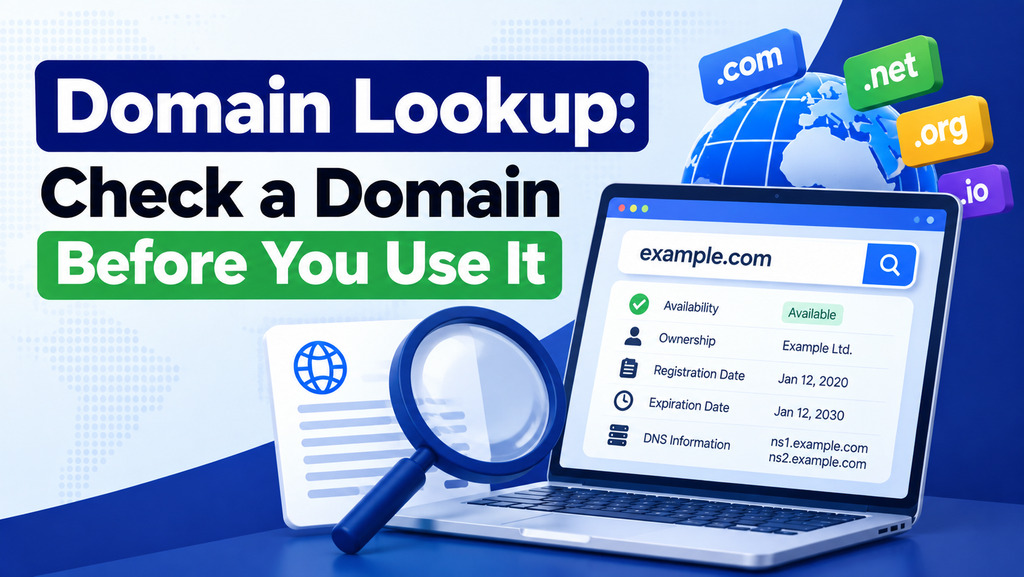
A domain lookup helps you check important information about a domain name before registering, buying, transferring, or connecting it to a website. It can show whether a domain is active, who manages the registration, which nameservers it uses, and how its DNS is configured.
Domain lookup is useful for website owners, developers, hosting users, and businesses. It gives you a quick way to verify a domain before making technical or financial decisions.
What Does Domain Lookup Mean?
domain lookup means searching public domain and DNS records to find information linked to a specific domain name.
A lookup may return details such as:
- Registration status
- Registrar name
- Creation date
- Expiration date
- Nameservers
- DNS records
- IP address
- Domain status codes
The exact information available depends on the domain extension, registrar, and privacy settings.
Why Should You Check a Domain?
Checking a domain helps you understand whether it is ready to use or whether there may be issues.
You can use domain lookup to:
- Check if a domain is available
- Confirm registration details
- Find the registrar
- Check expiration
- Verify nameservers
- Inspect DNS records
- Diagnose website problems
- Review email configuration
This makes domain lookup useful for both new and existing websites.
How to Check Domain Availability
A domain availability check tells you whether a domain is already registered.
For example:
mynewbrand.comIf the domain is not registered, it may be available for purchase. If it is already taken, you can try another name or another domain extension.
Availability can change quickly, so always recheck before registering.
What Is Domain Registration Information?
Domain registration information describes how a domain is registered and managed.
It may include:
- Registrar
- Registration date
- Renewal date
- Expiration date
- Domain status
- Nameservers
Some personal ownership information may be hidden because of privacy protection.
What Is a Domain Registrar?
A domain registrar is the company that manages a domain registration.
The registrar usually handles:
- Domain renewal
- Transfers
- Contact details
- Domain locking
- Authorization codes
The registrar and hosting provider do not have to be the same company.
How to Check a Domain Expiration Date
A domain lookup can often show when a domain is scheduled to expire.
This is important because an expired domain can eventually cause:
- Website downtime
- Email failure
- DNS interruption
- Loss of domain control
Domain owners should keep renewal information up to date and monitor important expiration dates.
What Are Nameservers?
Nameservers tell the internet where DNS records for a domain are managed.
Example:
ns1.examplehost.com
ns2.examplehost.com
If nameservers are wrong, the website may not load correctly.
Nameservers are especially important when moving a website between hosting providers.
What Is DNS Lookup?
DNS lookup checks the technical records attached to a domain.
These records control where website and email traffic should go.
Common DNS records include:
A Record
An A record connects a domain to an IPv4 address.
AAAA Record
An AAAA record connects a domain to an IPv6 address.
CNAME Record
A CNAME record points one hostname to another hostname.
MX Record
MX records tell email systems where messages should be delivered.
TXT Record
TXT records are commonly used for verification and email authentication.
NS Record
NS records identify the authoritative nameservers for the domain.
How Domain Lookup Helps With Hosting
Domain lookup is useful when a website is not loading or points to the wrong server.
You can check:
- A record
- Nameservers
- CNAME records
- Server IP
- DNS changes
For example, after moving a website to a new server, the A record may still point to the previous IP address.
A quick lookup can confirm whether DNS is the problem.
Domain Lookup for Email Problems
Email also depends on correct DNS records.
Important records include:
- MX
- SPF
- DKIM
- DMARC
If these records are missing or incorrect, emails may fail delivery or be marked as spam.
Domain lookup helps you confirm whether the required records exist.
Domain Lookup and WHOIS
WHOIS is a traditional system used to retrieve domain registration information.
It may show:
- Registrar
- Registration dates
- Domain status
- Nameservers
Personal information is often hidden or redacted today.
Domain lookup is broader because it may include both registration and DNS data.
Domain Lookup and RDAP
RDAP stands for Registration Data Access Protocol.
It is a newer method of retrieving domain registration information in a structured format.
RDAP can provide:
- Registrar details
- Registration dates
- Domain status
- Nameservers
- Registry information
It is commonly used by modern domain lookup systems.
Can You Find the Domain Owner?
Sometimes.
Some domain registrations expose limited ownership information, while others hide it using privacy protection.
Public results may still show:
- Registrar
- Registration dates
- Domain status
- Nameservers
Privacy protection does not change domain ownership. It only limits what information is publicly visible.
Domain Lookup Before Buying a Domain
Before buying an existing domain, check more than the registration status.
Review:
- Domain age
- Expiration date
- Registrar
- DNS configuration
- Previous website history
- Backlinks
- Spam history
- Trademark risks
A domain can have a long registration history but still have poor previous use.
Domain Lookup for Expired Domains
Expired domains usually go through several stages before becoming available again.
A typical process may include:
- Expiration
- Renewal period
- Redemption period
- Pending deletion
- Public availability
The exact lifecycle depends on the extension and registry.
Domain Lookup for SEO
Domain lookup can support technical SEO checks.
It can help identify:
- DNS problems
- Hosting migrations
- Domain expiration
- Nameserver changes
- Subdomain configuration
However, domain lookup does not measure ranking strength by itself.
SEO performance depends on content, backlinks, crawlability, indexing, speed, and relevance.
Domain Lookup for Website Migration
After moving a site to new hosting, check the domain configuration.
Verify:
- Nameservers
- A record
- CNAME records
- MX records
- DNS propagation
This helps confirm that traffic and email are reaching the correct services.
Domain Lookup vs Hosting Lookup
These tools check different parts of a website setup.
| Domain Lookup | Hosting Lookup |
|---|---|
| Checks domain registration | Checks hosting infrastructure |
| Shows registrar | May identify hosting provider |
| Shows expiration date | Shows server information |
| Shows nameservers | Shows network details |
| Checks DNS records | Focuses on hosting environment |
Both can be useful when troubleshooting a website.
Domain Lookup vs IP Lookup
A domain lookup starts with a domain name.
An IP lookup starts with an IP address.
IP lookup may show:
- Network provider
- ASN
- Hosting company
- Approximate server region
These tools are often used together during server and DNS troubleshooting.
Common Domain Lookup Problems
Domain information can sometimes appear incomplete or outdated.
Common reasons include:
- Privacy protection
- Recent DNS changes
- Cached records
- Recent domain transfers
- Registry delays
- Expired domain states
For important checks, compare registration data with current DNS information.
How Accurate Is Domain Lookup?
Domain lookup is generally accurate when the data comes from authoritative sources.
Recent changes may take time to appear because of DNS caching or registry update delays.
Third-party lookup systems may also temporarily display older information.
Frequently Asked Questions
What is domain lookup?
Domain lookup is the process of checking registration, DNS, and technical information related to a domain name.
Can I check whether a domain is available?
Yes. A domain lookup can show whether a domain is registered or potentially available.
Can domain lookup show the IP address?
Yes. DNS records can reveal the IP address currently connected to a domain.
Can domain lookup show the owner?
Sometimes, but personal information may be hidden because of privacy protection.
Can domain lookup help with website errors?
Yes. It can help identify incorrect nameservers, wrong DNS records, expired domains, or incorrect IP addresses.
Is domain lookup free?
Basic domain lookup is usually free. Advanced monitoring, historical records, bulk lookups, or API access may require payment.
Conclusion
A domain lookup provides a simple way to check registration details, nameservers, DNS records, expiration dates, IP information, and other domain data. It is useful before registering a domain, moving a website, troubleshooting DNS, configuring email, or buying an existing domain.
Checking domain information first can help prevent configuration errors, downtime, and registration problems.
Latest Post:
- How to Use DBI Installer on Nintendo Switch: Complete Beginner’s Guide
- Is DBI Safe for Nintendo Switch? Risks, Safety Tips, and What to Know
- How to Install DBI on Nintendo Switch: Complete Setup Guide
- Domain Lookup: Check a Domain Before You Use It
- How to Install Switch Games Using DBI: Safe and Legal Guide for Modded Nintendo Switch